Tuesday, April 14, 2015

early April


I have been, since last November, actively pursuing a teaching job in South Korea. The position would likely begin in late August 2015, depending on whether or not I end up being hired. My hopes are entirely set on this job. It is ideal for several reasons: I move out of Orange County, I travel, I enter a job where my creativity and experience are both relevant and useful. People keep telling me to have a plan B, but I am unable to do that. I will deal with it when it comes, I guess. If it does. 

Today I am working with about six or seven recruiters actively, and out of these, I really really enjoy my interactions with four. I have high hopes that one of them will help me find a good job. Unfortunately working towards an E2 (full-time working) visa for South Korea is an extensive and frustrating process. Before I started working with these recruiters I looked for at least an hour before I was able to feel like I wasn’t 100% confused about what documents were needed and how to get them. 

Anyway, there is a lot of hassle and cost involved in preparing visa documents. Right now I am attempting to acquire two FBI background checks. Since I have been working on this for several months now, I know exactly what I need. Finding these things is more difficult. 

I went into a little tiny Sheriff Services office in San Juan Capo’s downtown and was directed to a different location to be fingerprinted. The woman there wrote down the address and phone number of the place I was meant to go. Today I finally had time to go over after doing some online courses in the morning and headed over. When I park my car and walk towards the building a man passing me in the parking lot says hello, so I smile, then he says how are you? And I pass him without saying anything. I am not here to chat, Mr. Stranger, I am just minding my own business. I can already tell this is going to be a horrible day.  

I get to the building and it’s a city-council building. I know I am not in the right place, but I head into the first manned office I see to ask where to go. The lady there points me in the direction of two places: first, the sheriff’s office across the street, where she tells me I need to have an appointment (so it is not an option--the lady in SJC told me I did not need an appt, but she also told me the wrong place to go, so...), and then there was a building across the parking lot where they took walk-ins. 

I head to the location across the parking lot and walk into Live Scan Services. It’s a stuffy, small suite. I sign in and sit down. I listen to the man working there as he interacts with prior clients; he is kind of curt and impatient, and I think, great. I just know this is a bad idea. But I wait it out, call me dumb. He comes out and asks me who sent me here. I am thrown off by this question. That isn’t any of your business, how about you ask me what I need? I end up saying I am here because I need fingerprints done for a background check, and he asks why, and I say for a visa, and then he asks for what kind, and I tell him for a working visa for South Korea and he says so you need an FBI background check... and I just say yeah. Then he goes to get a plaque off the wall to show me what an FBI background check looks like. I want to say, look, Mr., you’re talking to me like I’m dumb and don’t know anything, but I think I actually know more than you. What I do say out loud is that I have been working on this for a couple months, so I am familiar with the process. Then he goes on to say that for South Korea I will need an apostille and shows me what an apostille is and explains that it’s costly etc etc, as if I don’t and couldn’t know already. Both are wrong. I know exactly what these things are and how to get them and how much it will cost me. Does he think I just woke up this morning and decided to teach abroad? 

It gets to the point where I confuse him so badly by making logical, concise statements about what I need, that he makes me come into his office while he works on his next client’s paperwork to tell him again that I need two FBI background checks, to send to different places, but that I am not here for those, just for fingerprints. Then he wants to know about the places I want to send the background checks. I tell him at first, and then I give up when he starts to tell me things that don’t matter to me and do not pertain to my situation. I say, look, I just need fingerprints. It doesn’t matter on your end where the background checks go after I get them. I will deal with that. And he finally says, well you’re just not speaking my language so I don’t know what you want. But I guess I can just give you inked prints. (WHICH IS WHAT I CAME IN SAYING I NEEDED!!!!!!)

He speaks to me disrespectfully, assuming I know nothing, and assuming that I am dumb because I do not understand what he’s saying. I feel like I made it clear that I didn’t care what he was saying because it wasn’t relevant to me, not because I was like, wait, what are you saying, you’re making too much sense. I understand him perfectly, except when he goes into vague broad statements like well every school has their own background form, so I don’t know who your employer is, and I’m confused about what to give you. 

He handed me two forms for inked sets after deciding I was an imbecile incapable of listening to reason. I went to sit down and fill them out, but then I thought, I don’t need to do this here. On top of everything else, his fingerprint cards were more expensive than I had been told to expect. So after a moment I stood up and threw out the form I’d filled out partially and left. I felt like standing in the doorway and shouting by the way! I am at least twice as smart as you!!!! But that’s not really like me, and he would have just been confused anyway. 

((Moral of the story: do not, ever, go to Live Scan Services in Aliso Viejo, CA, if you are a young woman without anyone else with you. I have a distinct feeling that if my dad had been with me, the man there would not have treated me like he did. I often have this experience. I have a young face and I am a woman, so people automatically talk to me in a certain tone and lack a certain respect for my ability to comprehend more of a situation than they are probably able to. But whenever I bring my dad with me, they don’t even try it with him. This is extremely frustrating. Women with slightly more aggressive attitudes are also taken a lot more seriously, but even then, I’ve experienced with my younger sister (who is definitely kind of intimidating when she needs to be) that men, especially, and even male peers, do not take her/me seriously. They always assume that we know less than we do and that what we want is unreasonable somehow. Yet my dad makes the same exact request in the same language and they don’t question him at all. Part of this is because he is notably older. Part of it is that he is a man, more expected to know about this stuff. Anyway. NIGHTMARE.))

Anyway, today. After leaving Live Scan Services, I drove across the street to the sheriff’s department to ask to make an appointment for a later date, or to see if it were a possibility they didn’t actually require appointments and the lady at city council was just wrong. Of course, I step in there and within two minutes the front-desk people are joking with me and smiling, friendly, and telling me I don’t need an appointment. They were even willing to make prints for me that day even though it was already 4.30 and they usually stop doing prints at 4. Unfortunately since I didn’t have exact change on me (or any cash / check) I wasn’t able to do it today. But I know that I’ll walk in there tomorrow and out within an hour or less and have everything I need, hassle-free. 

There are so many things wrong with what happened here that I can’t even tell if any of it was my fault. The information online about getting fingerprinted is a bit outdated. The information that the lady in San Juan gave me was just flat out incorrect. (I mean, not all of it. The prices and the fact that they take walk-ins was helpful even though it was contested later. And the correct address was across the street. But still. Come on.) The Live Scan Services was a nightmare. The sheriff people were so helpful and nice I almost cried all over them. I may still do this tomorrow. 

It's also extremely difficult to find information online about the process of getting your Criminal Background Check through a channeler and then apostilled after that. But it isn’t that I didn’t do my research. I did. I am pretty comfortable with research and I always do my best to find out everything I can before asking someone for help. But I still only feel like I know what to do because I am working with very helpful recruiters. I decided a while ago that after this process is over for me and done with and problems are kneaded out and I have a helpful point of view, I’ll just write an article about my experience and find a way to put it online. It’s really ridiculous how hard it is to find info online. The process is complicated, yeah, but when things are explained orderly and correctly, it doesn’t seem so intimidating anymore. 

There have been times like today throughout this whole process that make me just want to give up because everything seems stacked against me and I am doing this alone, I don't know anyone who has done this before and even when I know I am headed in the right direction I still run into so many difficulties. Why is it so difficult? Even if the rest of my life were happy and calm, this would still be disturbing, but beyond this, nothing in my life is easy right now, everything is turbulent and frightening. 

I’m trying so hard to enjoy this time before I leave, but I’m not having much help with that. People make decisions about me and then treat me a certain way based on these ideas--but they’re wrong so much of the time, not having taken the time to try to understand me or what I need or want. I am used to this--I’m quiet, so people think I’m unfriendly or I dislike them. I’m not social, so people think I’m unfriendly. I’m young, so I must not know anything... I am used to this, but I am getting tired. How much can I take? I feel bad about being glad to leave. But given certain things...how could I not be? 

Despite everything, I am still determined to make this happen. I feel so much that I could be useful and fun as an English teacher, that I have something to offer as an English teacher--and beyond this, that Korea has a lot to offer me, as well. I’m waiting right now for my life to start. 

Transitions aren’t ever easy, are they? I think about this a lot. I visited UCI recently and watched students in the student center enviously, fondly, in other ways that I couldn’t name. I think about it. Transitions.... I think and I come to this--it makes sense. It simply is. Even our bodies are full of strange contraptions at the joins, a lot of tendons and bundles and sockets and irregular shapes. 

Tuesday, October 7, 2014

the great wall

It’s now October. I recently revisited Beijing for a piece of fiction. I was trying to write my second-ever (poetry) piece for spoken word, but I keep getting caught up in the loping energy of long sentences, the way they move in compact bursts, and fold up like a loaded spring. I like sentences. I’ve come to know this about myself recently—during the last year of college I figured out that I was actually hopelessly confused about line breaks in poetry despite having taken so many courses in poetry and that instead I was confident in and curious about syntax, so it’s just happened that I return to the sentence when I really, really want to say something, or when something’s asking me to say it. So the subject matter of my spoken word piece will turn out to be something other than China, I believe. 

I’m listening to Clair de Lune. I think I’d like to go back to the Temple of Heaven and just sit there, listening this way. While I was there I was reminded of the view from the Sacre Coure in Paris. You can just see…everything, but nothing in detail. And that kind of dual vision puts an auditory damper on everything, so it seems like it’s just you and that endlessness that was waiting for you there.


It’s difficult for me to write about my experience in China in direct words like I did for the first two Beijing posts you can see here. Instead, when I go to write about China I find myself immersed in the world I’ve created, safely apart, a distance precisely controlled and occasionally, purposefully, violated, of my characters. Last March, additional to the work I did for the short stories that I included in my senior thesis, I spent two days (nights, more truthfully) writing a three-chapter short story that I have, this summer, reworked and to which I find that I continually return when something about my experiences over the summer occurs to me. The story’s always had the same rough outline, which has always, even in March before I’d set foot in Asia at all, included description of Beijing. Now I just have the experiential memory to pad out (or, more often, completely change) the scenes I’d already written.

For example, the Great Wall of China. Thinking about this without having ever seen it, I thought it’d be maybe even fun to climb it. And I thought that, maybe, the word “climb” was just a word you had to use in conjunction with “the Great Wall” because it was a phrase, not because the actual activity involved … climbing. So when I wrote of it, I wrote of it wrongly. I forgot the most important things about the Great Wall in the summer—first, it’s over 100 degrees. Your skin is probably melting off your bones. People’s umbrellas are getting ing your face. Second, parts of it are nearly vertical tilt and required the use of arms as well as legs to ascend. You look like a monkey rambling up certain giant steps. Third—it is really, really, really high up. It’s in the mountains. As someone who is afraid of heights, I quickly found myself getting queasy looking down from the low heights to which I was actually able to climb. The hand rail was really low, too, so using it was more difficult than the weird crab walk you had to do to get down the stairs without using it. 

I didn’t write about any of that last March, during those midnights in which I imagined something flatter and less full of domestic tourists and walking upon which didn’t induce the types of exhaustion that it in fact turned out to. In my story there was too much chatter there, too much bodiless gazing out. I forgot the body. In fact the real experience was only and all about the body. The body’s interaction with culture, history, itself. For me personally it may have been metaphorical for the mental struggle I constantly re-encounter when I ask myself to justify my interest in a culture or set of cultures that doesn’t belong to me at all and the struggles to encounter the culture beyond its commodities, or the obvious. Still, though mentally I am pretty qualified to tackle these struggles, physically I am too afraid of heights and too weak and short-legged to have climbed high enough to reach one of those little stalls on the wall where you can purchase a plaque that says that you are a “real man,” now that you have climbed the Great Wall. Declaring that until you’ve climbed the great wall you are in fact, incapable of becoming a real man. It’s a comfort to me that I’m not, and have not been, concerned with becoming, or proving to anyone that I have officially become, a real man….
When we were first entering the landmark, there were a few nice areas to walk around and look out at the mountains before heading into the actual wall through the gates. While we were there I was approached by a boy with his parents. He didn’t speak any English but I understood that he wanted to take a picture with me. His dad made eye-contact with me that I will probably not ever forget and I don’t know exactly what he was thinking, but his son chattered something to him that made him take off in the direction of the gate without a glance back at us. My roommate for the trip managed to catch a picture of the picture-taking from a little ways off. After that the boy said more things to me in Chinese and I just nodded. He could have said anything. And then he asked to take one with my roommate, too. 

Several others asked me for photos while I was on the wall. Some didn’t even ask. Some wrapped their arms around my shoulders, some stood primly next to me. One young woman came out of nowhere and asked if I’d pose for a photo with her mother. The fascination of certain Chinese with foreigners is something about which I am still largely undecided. Of course fundamentally I will never understand the motivations: I grew up in a country of considerable diversity, while China, on the other hand, despite being comprised of fifty-something native races, is 95% Han…. So while I wasn’t thrilled at the attention, and while this experience has made me more wary of relocating to China for any considerable amount of time like one day, a while ago, I thought I might have liked to do, I can be amused about it, thinking back. 

Opposed to this were the people who tried to carry on conversations with me in Chinese on the wall—when I was walking back down, alone, there was an old grandpa in a straw hat, to whom I’d motioned to use the handrail and had grabbed the sleeve of his jacket to move him over to the edge of the wall after he’d stood for a few seconds longer than necessary staring down at the next step…there were a couple groups of small children, one woman selling kites down outside of the gates, and the already-mentioned selfie-boy. Other than not knowing what to do while this was happening—just smiling and nodding if I thought I should—I found these encounters bizarre and kind of sad. 

More than the Great Wall, I keep thinking and revisiting taxi rides, subway rides, walking miles and miles, a little lost, while sick, through the inner city and night markets. The peculiar and piquant scent of Beijing summers. The white dust in the inner city that falls from the sky like snow. And most of all I keep thinking about the Temple of Heaven, the gaze out from that place. Maybe because it was the first place we went, while everything was still new, magical, and yet while I was still waiting for this to feel like I was on the other side of the earth.


Monday, July 28, 2014

beijing day one

I looked back through my journals about London, the first couple days I landed there, to see if I might have experienced the same kind of waiting sensation there that I experienced for the first couple days in Beijing. I don’t have a record of it anywhere. I remember London—smelled like hot metal and tarmac the first day I was there, and when I surfaced from the underground bits of dust and lint got caught on my greasy face and in my eyelashes and people looked at me like I was a sewer monster as I hauled my luggage first half a mile in the complete wrong direction, and then back after consulting my map for another mile. It felt real. It felt like a whole new world.

Maybe because we hear so much about how the East is different, I expected to feel like I was in outer space or something. So for a while, when there was more greenery around than I had expected, and when the sun was whiter than I’d expected, when the air was cleaner than I’d expected—I kept waiting to feel like I was in China. I was still isolated at this point, like a little Western virus caught up in quarantine, on the tour bus. I couldn’t wait to step out.

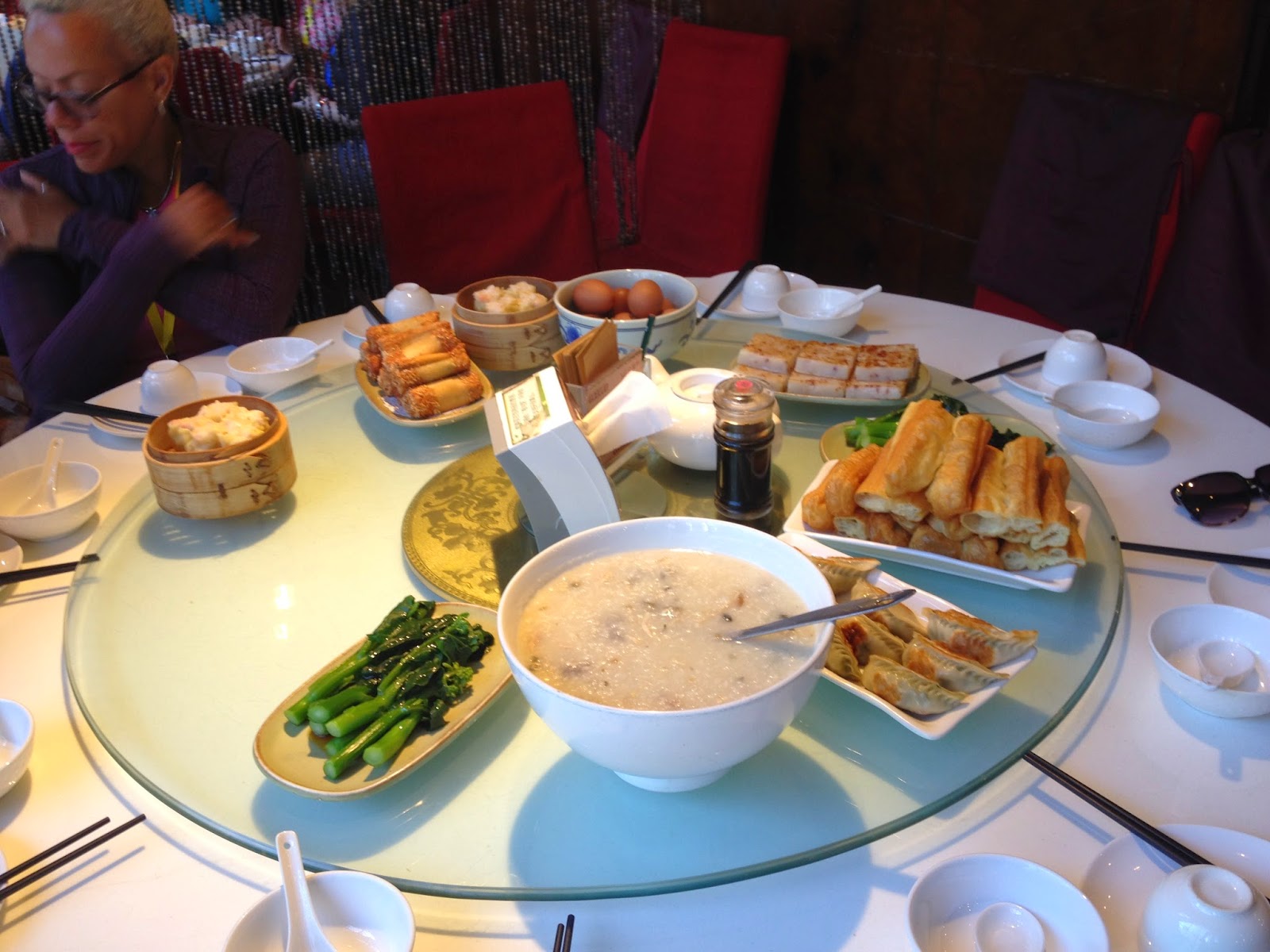
The first stop was a restaurant where we climbed up to the second floor and, next to a window display full of dried-out Peking Ducks, ate dim sum. I have no idea what is in that loaf thing but I ate some and then someone at the same table decided that there was fish in it. I thought, great, we’ve only been off the plane for an hour. (I would later eat fried fish/eel thinking that it was fried mushroom…but we didn’t get a lot of help distinguishing what was what. Also, for those of you reading who didn’t know, I’ve been a vegetarian for a while now, since about half-way through high school.) 


dim sum for breakfast: morning 1 :')

After breakfast we took the bus back to the hotel. It wasn’t too hot yet; I’d already fooled myself into thinking that the weather wouldn’t be as bad as they’d warned me, and this delusion persisted for the first few days. 

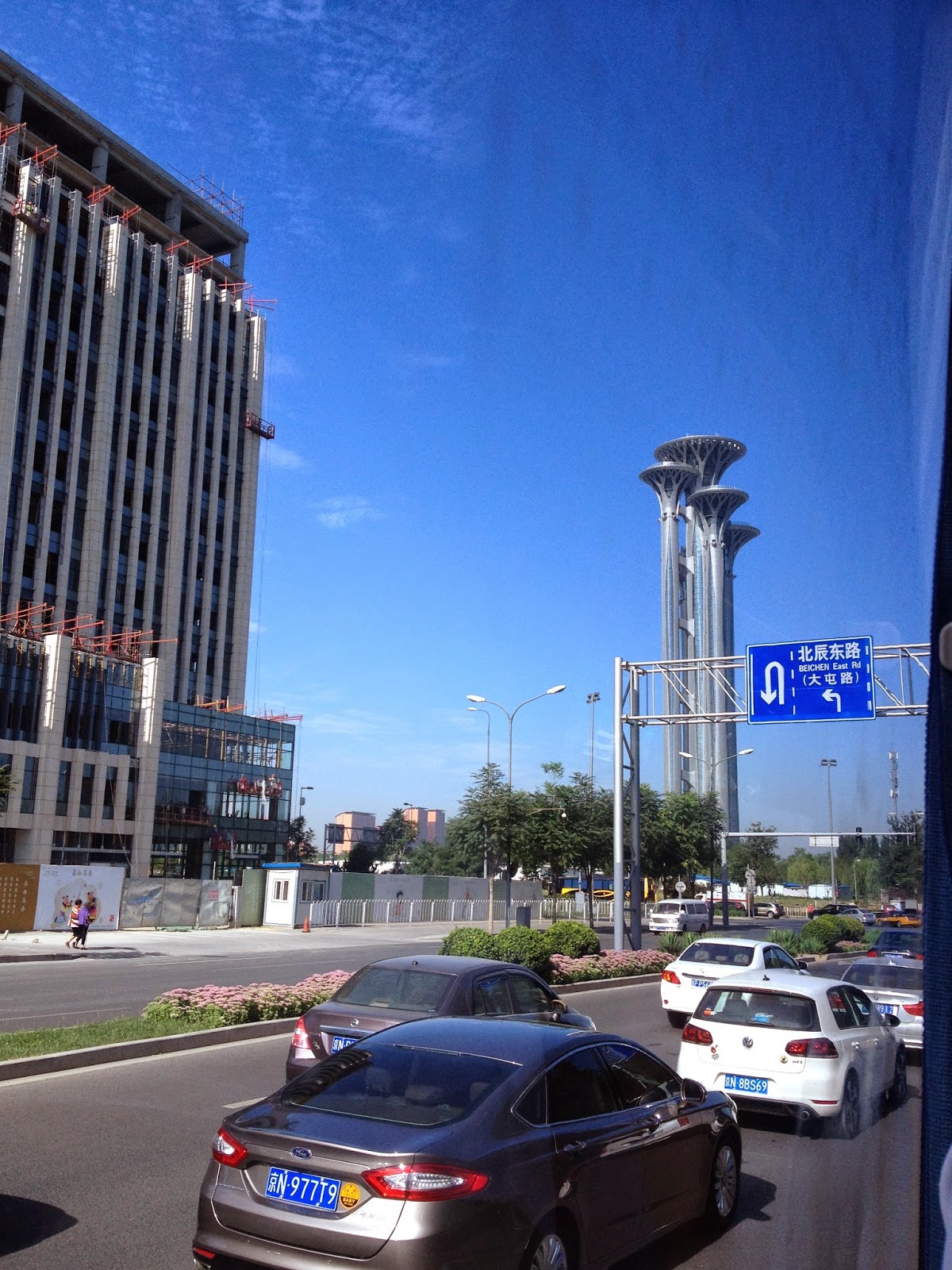
mysterious mushroom buildings
I don’t know what these little mushroom-looking buildings are, but you can see them from really far away if the air is clear. Beijing is full of high-rise apartments—not as many as Shanghai—but enough so that early views of Beijing reminded me of the first views of London from the surface-level areas of the underground. For some reason I cannot feel as romantically about Beijing as I felt about London.  

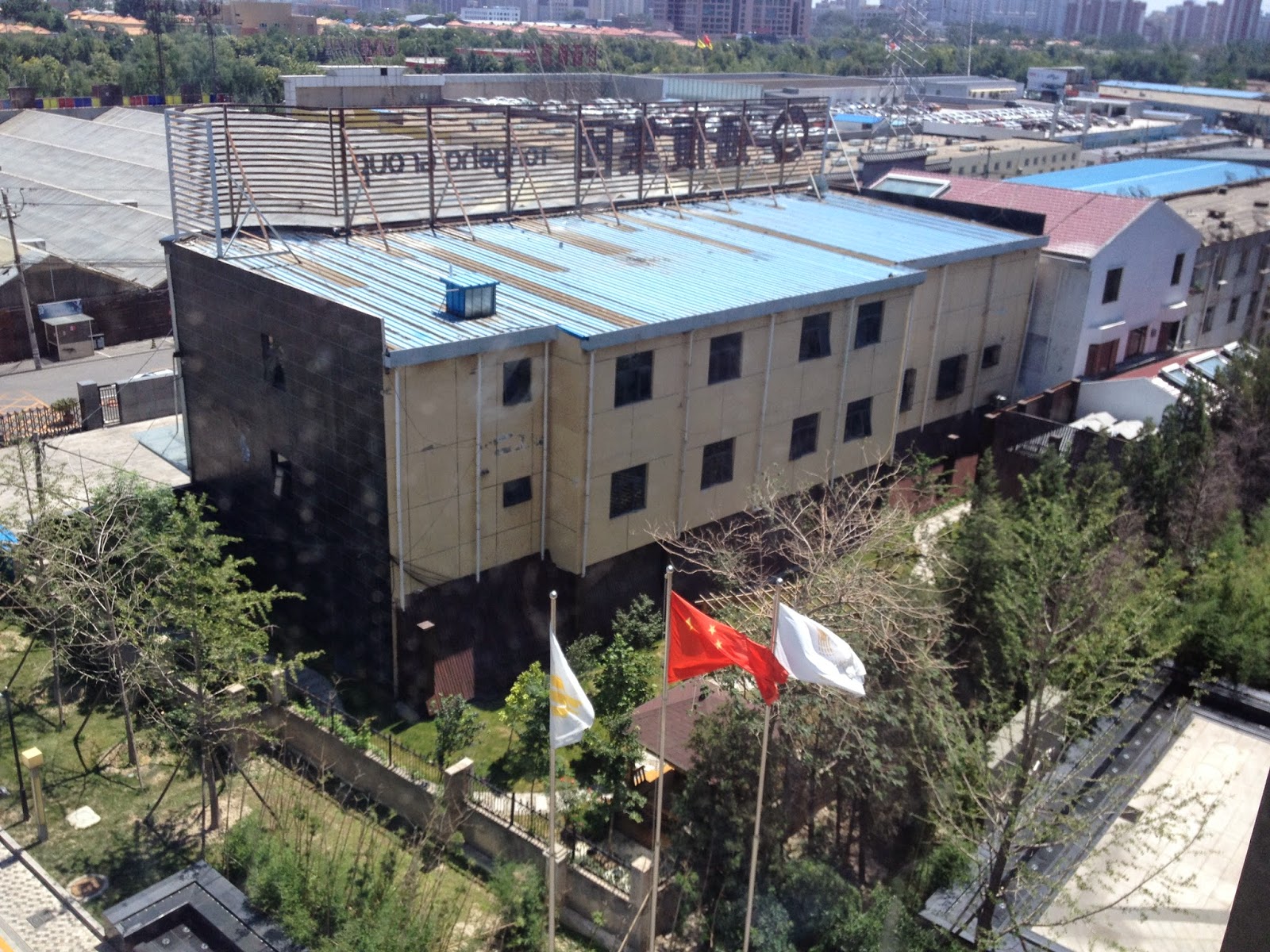
Below is the view from our hotel window. We stayed at the Taishan Hotel for the duration of our Beijing stay; my roommate “A” and I were on the fifth floor. Because she attended an optional event that I did not attend on the first morning, I checked in to the room alone and was left to explore all its strange plugs and devices on my own. Unsurprisingly it took me five whole minutes of pressing the light switches to realize that there’s a slot near the door where you have to insert your room key for the power to even come on. After I figured this out I turned the air down as low as it would go which was still too hot, around 28C—I think A came back later and figured out how to get it to go lower than that. 

Our bathroom was really nice, but one whole wall was made of window. I could see there was a blind but I couldn’t reach it. At this point there were two hours left until we left the hotel for lunch and I’d just been on a long international flight and I wanted to shower, so I just undressed and showered with the window open. We were on the fifth floor. Hello, Beijing


view from hotel window
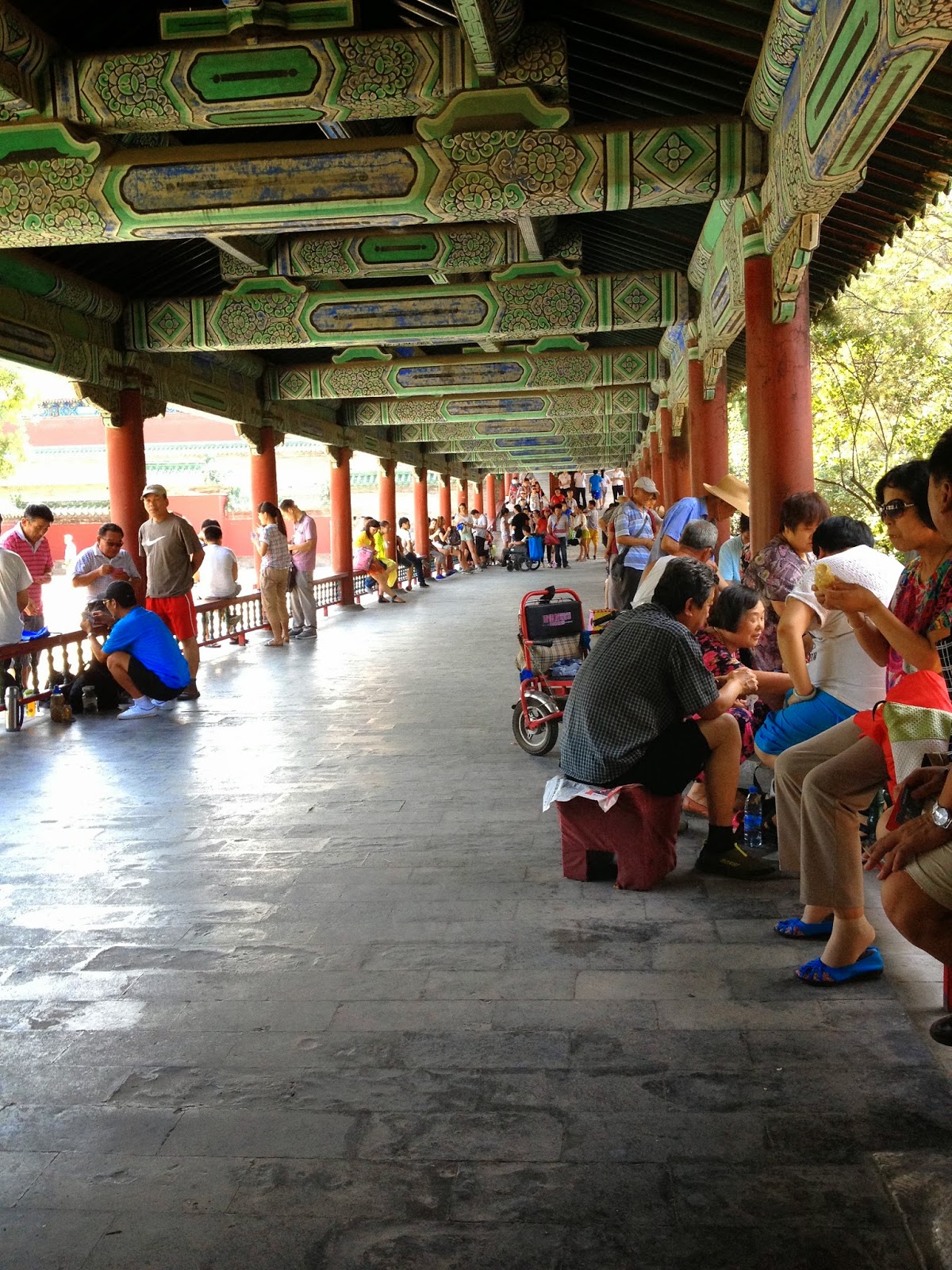
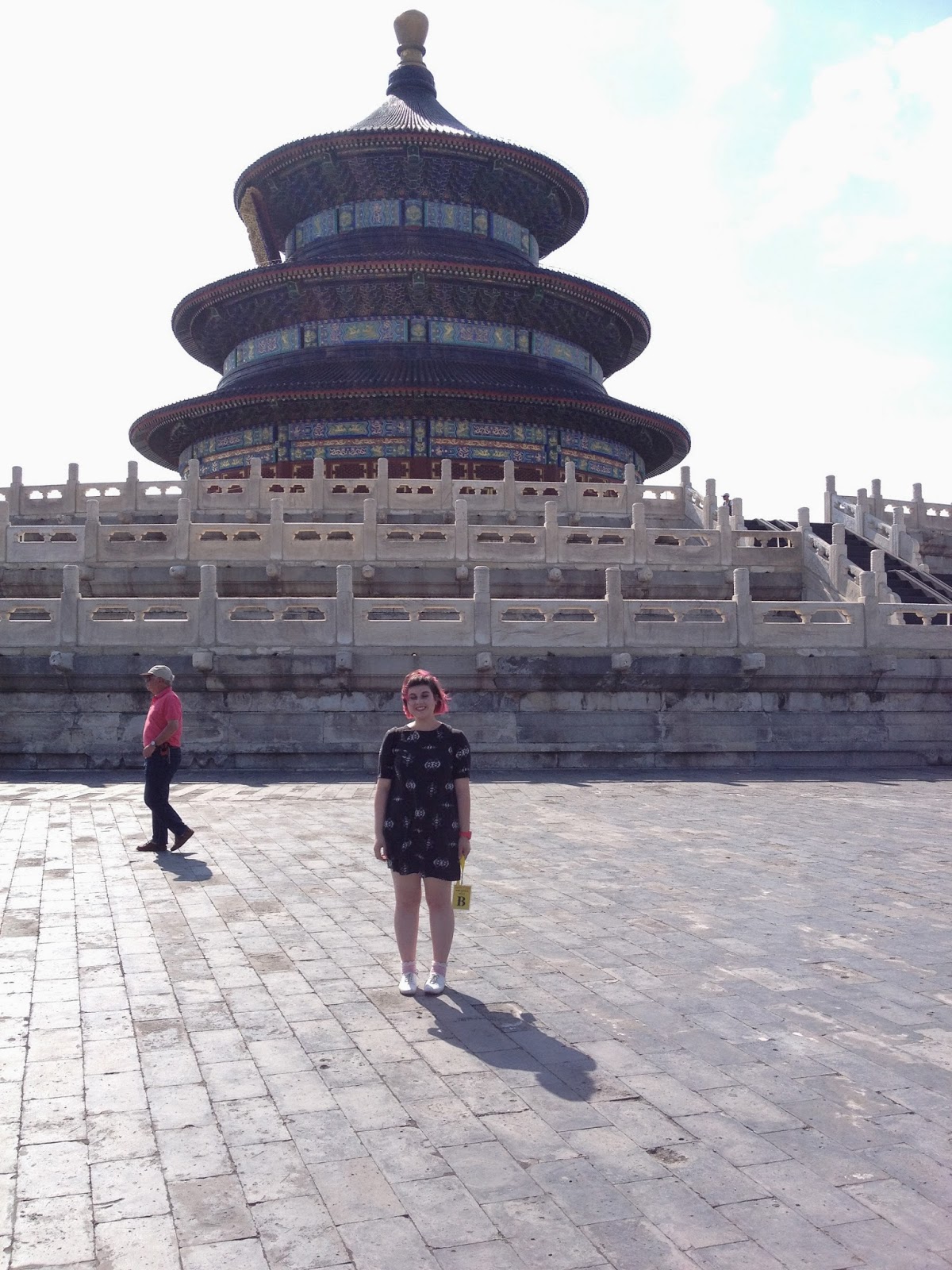
Later, after lunch (Peking Duck, which I heard was good), we went to the Temple of Heaven. Thinking back about it, this is still one of my favorite stops that we made in Beijing. Flocks of tourists, of course, but there’s also a lower level where a bunch of locals gather to play chess and blast music out of boom-boxes (yes!). Some people’s game stations appeared to be permanent—some chairs were chained to the ground… I liked walking at ground level. I didn’t like being part of a tour. I’ve had the feeling before about other things but I feel kind of …fake? For being interested in these cultures to which I have no real claim other than my own interest…walking around with a tour wearing bright yellow tags did nothing to assuage these feelings. I took mine off after a while and held it in my hand. 

The Temple of Heaven was built in the 15th century, and was the site of heaven worship, the place where Ming and Qing emperors would come to pray for good harvests. There’s the temple, but then there’s also a park around it. I’ve experienced the feeling before in Europe, but more here: how strange that it’s places like these and the things that happened here a long time ago that shaped the culture of the domestic tourists who were coming to visit them… Americans don’t know what it’s like to live in a country where there’s a cultural rule of any kind—our culture is freedom of speech and back-porch barbecues, cheap fast-food and football season’s extravagant chex-mix-filled parties….Southern California is about healthy living, clean seafood, being in the water as much as you can, being bronzed and happy…. But those are all things of right now, we don’t have anything to look back on. And I think it’s why we can feel a little lost sometimes, just as a generation, especially us millennials, for whom the internet has so compressed space and time that we might as well have not been born into anything at all… 


The first person who asked to take a picture with me asked while we were at the Temple of Heaven. I thought I heard him wrong. But I wasn’t wrong. This continued to punctuate my experiences in China…something I’ve been struggling to think of fondly rather than as too strange to enjoy in memory. Just another bit of culture shock…more on this later. 

The sun set on us in Beijing after a long, long day. I kept thinking about “Concerning the Wild Goose Pagoda” by Han Dong on the bus ride back to the hotel. When we reached the hotel A, my roommate, figured out how to use all the things that I had failed to, including how to lower the blind on the bathroom wall…

I discovered the poetry of Han Dong this last Spring, just picked up a book at random in the library and it wouldn’t leave me alone, haunted me… I’m still in the process of writing up a paper about Han Dong’s poems. I sent my dad a few of his poems after we watched a documentary called “Wild China” a few months ago; Han Dong is a contemporary poet, and I started to think a lot about contemporary vs. ancient China. I wrote this:
  • This came to mind while we were watching the "Wild China" series last night...I think that a lot of Western understanding of Eastern Asian culture(s) is rooted in an understanding of the "Ancient" Chinese or ancient Korean or ancient Japanese. It's true that a lot of this ancient culture has, because of the culture's age as a whole, managed to dominate even parts of modernized culture, but I like reading these "contemporary" poems as a comment on contemporary Chinese life. I think in a culture as old as the Chinese culture, a perspective on contemporary life probably isn't possible or meaningful without a comparison to the culture's history. I hadn't thought about what you said about the peaceful tone I perceived in the poems before you put it the way you did; that culture and life have just existed in certain ways that have persisted for thousands of years; and now that I'm reading again through them, I'm reading the poems less as a comparison of old and emergent, but as the ways in which an ancient culture reforms itself to fit the current era...it reappears in forms that are familiar and strange, but it's all part of the same, ancient cycle. "Concerning the Wild Goose Pagoda" draws the most noticeable parallels between the past and present; even in a place of so much history, how much can we really know about it just by being alive there today? It's something I experienced in England, when I was amazed by the buildings and how old the streets were, and people just went around living because life changes even if landscape doesn't. SO the poem reframes bravery as the ability to enact vision or to respond to desire and not to disappear into life as though you hadn't climbed to the top of the ancient building at all.


Despite the obvious dark tones (which went over my head the first time I read this poem), I love this piece. It may just be Han Dong’s writing in particular, but reading Chinese poetry often leaves me feeling peaceful, but awakened. It haunts you for a while afterward, too; from the first time I read “Full Moon” by Du Fu last year I haven’t been able to think of the moon without thinking of it (not yet flawed, it drifts...). I can’t go to China, therefore, without thinking of Han Dong… This piece caused quite a stir when it was first published in 1982. 


From Eight Contemporary Chinese Poets by Tao and Prince from Wild Peony Press in 2006:


“Concerning the Wild Goose Pagoda” (Han Dong) 

Concerning the Wild Goose Pagoda
How much can we really know
Many people rush here from far away
To climb to the top
And be a hero for once
Or in some cases twice
Or even more
The frustrated and the disconsolate
The plump and the prosperous
All climb to the top
Play the hero
And then come down
Walk into the street
And immediately vanish
Some work up the courage to jump
And leave a red flower on the steps
That's the way to be a real hero
A hero for the modern age
Of the Wild Goose Pagoda
How much can we really know
We climb to the top
Gaze around at the scenery
And then come down again


writing music: “Icarus Walks” by Epik High


Daedalus made a pair of wax wings for his son, Icarus. After that we remember what happens: Icarus uses his wings to escape captivity and then realizes that he’s curious for the world; over the ocean he flies too close to the sun. When he turns around to see that his wings are melting and realizes what’s happening, he begins to fall; he drowns in the ocean below. 

Pieces, part one is an album that I have really come to love recently. At the end of the school year when I was starting to really wonder about what to do and who I am, I could really only see my love for writing as the thing that grounded me to the world and that would allow me to relate to and interact with others. My world kept getting darker. I feel like I’m still sitting in blackness. Pieces, part one also includes “연필깎이” and “낙화” which are about living through the blindness (연필깎이) and maintaining your dreams despite them being impossible (낙화). The album rewards belief and hard work, but also curiosity and positive attitude. It doesn’t do it in a way I’ve seen before—not a YA anything is possible if you believe kind of message. It’s about being in a time when you feel far away from yourself and imagining what you must look like, wherever you are, and continuing to walk even in the darkness, when there’s no way to tell where your foot will fall.

“Icarus Walks” retells the myth we all know. The greeks were obsessed with hubris, the ways it could kill a person. If you angered the gods you were dead. But Pieces, part one is a different framework. We’re not in ancient Greece anymore; this is a world of cities and shadows and facade and noise that muffles the heart’s own language, where the choice between what mask to wear can consume the face that would support it (re: “nocturne” and many others from Remapping the Human Soul, the last album prior to p.p1). In this kind of landscape, the gods may have forgotten us, or found a better world. It’s now humans with the capacity to inspire and help each other through ugliness and periods of fugue. In Pieces, part one, when Icarus falls to the water, something else happens at the surface, and when we realize it, something else can happen inside us, too. 


Saturday, July 26, 2014

beijing airport


Beijing Capital International Airport is bigger and hotter than I would have expected. The ceilings are arched and white, planks of wood criss-crossing over something orange behind them. When we landed at five-something AM the first morning, it was also nearly empty. Beijing Capital is the most highly-trafficked international airport in Asia. ...Maybe because of this, someday, they will decide to invest in air conditioning. 

It took five minutes, maybe a little longer, maybe closer to ten minutes, to walk from the plane to immigration. While I was there the officer helping me talked with the officer at the other booth about something that amused them both. I’d just spent twelve horrible hours not sleeping at all but being the couch cushion for the little boy in the seat next to me; whatever they said didn’t amuse me. I don’t like flying. 

I do like airports. After you pass through immigration you walk through this wide part with a bunch of banners in different languages welcoming you to Beijing, then go down escalators to wait for a train that will take you to customs and baggage claim. I can’t remember exactly what it’s like when you get off the train. I think I may have walked straight to baggage claim and then strait out into whatever the part of the airport is called where people can wait to pick you up. 


I have a few impressions of what happened next: it was too hot in the airport, I needed to shower, and I got accosted by a taxi driver immediately after claiming my baggage. Several others asked me if I needed a ride while I walked the gamut. We’d been told someone from the travel agency would be waiting for us when we go there. There was nobody there. I went and stood with a couple people I recognized as part of the same group. Around us a man got into a loud verbal argument with someone a little passive until a girl maybe my age went up and pushed him around until he quieted down. Couldn’t tell if they were siblings or just star-connected strangers. 

Other than the fact that all signs were in Chinese and that announcements were made in Chinese first and in English second, I kept waiting for it to feel real. I think because when I was in Europe, the weather was so immediately different from what I’ve ever experienced, it really did feel like the other side of the world. It was just hot in Beijing, heat that I’ve felt and hated, too, at home. 

I watched people gather each other, walk aimlessly through the airport’s lower levels. Everything shines in airports. It’s all cleaner than you think it would be. Whiter, too. Feels a little like you’re all passing through some giant animal’s body, just for a time, until you exit into the world full of weather and dirt. 


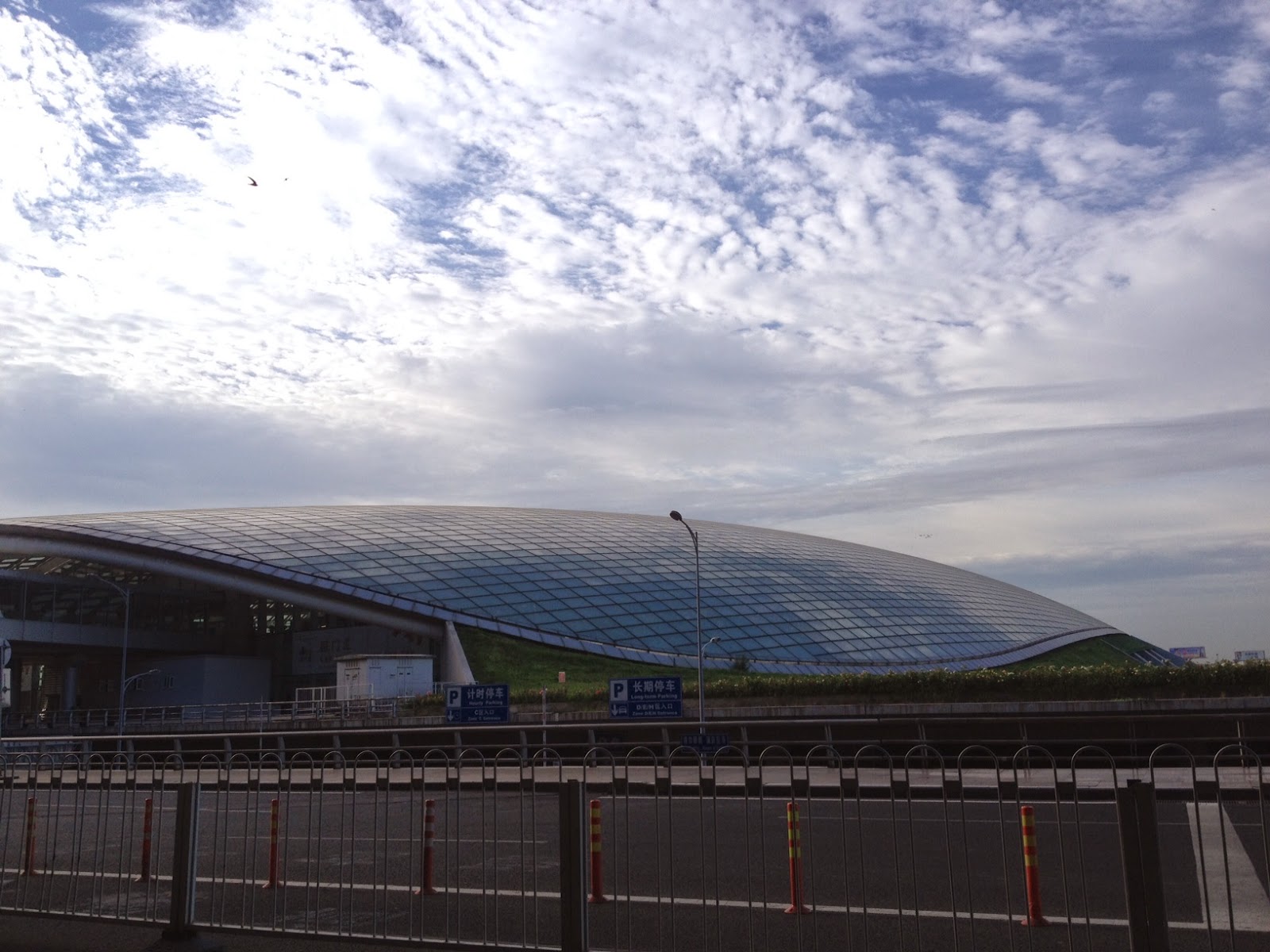
The view from outside the airport is different. There was this small, shiny, pancake-shaped building across from our bus. It turned out to be a small introduction to a city full of strangely-shaped or strangely-decorated buildings. My first thoughts of Beijing were that I was waiting for it to feel real, but it’s a vigorous city, robustly itself, populated in part by one of the most technologically advanced generations in the world and in part by older men and women with traditional haircuts and who still wear those little black fabric shoes. People ride bikes and electric scooters right into traffic. People walk right into traffic. There’s more greenery—shrubs, trees, parks—than I had imagined. The city is larger than I ever thought. Its people are friendly and interested. Chatty. I wonder how long Beijing will sustain the traditions of its long history; how long it should; how people like me affect what happens there; will we continue to be a pest to the kite-sellers from whom we will not buy…


Friday, July 25, 2014

late July


Some changes: I’ve reverted several posts to drafts while I clean them up. In the meantime, I plan to continue to review music and books (I recently began reading A History of the World in 10 and 1/2 Chapters by Julian Barnes and recently finished reading Black Aperture by Matt Rasmussen and 1Q84 by Haruki Murakami; recently dug up old writing on Laura Marling’s Once I Was an Eagle and Epik High’s “Icarus Walks” —), and to write a little bit about my recent trip to Beijing and a few cities in Southern China. 

I keep applying for jobs. We’ll see what happens. I recently told some friends that if money was no issue, if getting the jobs I wanted was no issue, the life I envision for myself: I’d like to go to art/fashion school, study textile design or menswear design, work my way into the product acquisition/styling industry; at some point during this time I’d travel to Eastern Asia again to teach English for a year or two. I’d attend foreign language school in Seoul like I wanted. Write that paper on the link between portrayal of women in modern/contemporary South Korean literature and the disappearance of the homeless women during the IMF crisis. Then I’d like to go back to school for an MFA in Creative Writing and enter the literary professional world. 

I spent a long time thinking that writing was the only interest I had, and time with nothing to do has given me the understanding that I’d like to do other things, too. I’m realizing more and more that a single “calling” is another myth that we ingest and promulgate to keep our ideas of our own selves from going out. At a certain point myths don’t convince us anymore. 

From Robert Frost’s “On Looking Up By Chance at the Constellations” —

The sun and moon get crossed, but they never touch,
Nor strike our fire from each other nor crash out loud.
The planets seem to interfere in their curves
But nothing ever happens, no harm is done.
We may as well go patiently on with our life,
And look elsewhere than to stars and moon and sun
For the shocks and changes we need to keep us sane.

Saturday, April 19, 2014

these boys are now fertilizing daffodils

poetry was popular in Hell, the shades
recited lines they had memorized—forgetful
even of who they were, but famished for life.

from  “Eurydice and Stalin” by Robert Pinsky

Wednesday, April 9, 2014

writing music: angst (playlist)

PLAYLIST: WRITING MUSIC


Can also be called “relationships gone wrong” playlist or “there are a lot of things I wish I did better” playlist or “unstuffing my heart” playlist; listen to these songs while you’re writing through character-relationship conflicts, through uninitiated longing, through hesitation, through self-doubt, through characters’ awarenesses of their own flaws and their hesitation to act because of it. Listen while you’re getting to write a character who’s in pain because of how closely she can listen to her heart. Regret, heartache, missed opportunity, restlessness. 

But angst can also be, like, being in love with somebody. Angst can be anything (if you just belieeeeeevvvvve). 

Some of these listed below are my favorite songs in general. I remember listening to “Drops in the River” when I was driving up the I-5 from San Diego alone during the summer of 2012, looking out at the ocean with the windows rolled down, blue hair all over the place, just feeling really…. Well. You’ll know if you listen. Laura Marling is just perfect in every way and I like her music so much that I can’t think of anything actually helpful to say about it (at the moment), but there’s a theme amongst her songs of hosting darkness that’s really powerful. “Within” by Daft Punk is the one, though, that I can pretty much count on whenever, wherever, if I need to get down to a tough scene. I think it’s universally…true. And, at the end of my second year of college, I wrote an entire novella in two weeks listening to  “Sim Sala Bim,” so you can be sure it’s good. 


These are only a few of the songs I have in a writing playlist at the moment; I’ll continue to post suggestions as I continue to work. 


1. “The Beast” by Laura Marling
2. “Lonely Lonely” by Feist
3. “Within” by Daft Punk 
4. “Where Can I Go?” by Laura Marling
5. “Drops in the River” by Fleet Foxes
6. “When Were you Happy?” by Laura Marling
7. “When Doves Cry” by Alex Clare
8. “Too Close” by Vitamin String Quartet (Alex Clare cover)
9. “눈, 코, 입” by AkMu (Taeyang cover - THESE PPL ARE SO GOOD ;;) 
10. “Honey Honey” by Feist
11. “Sim Sala Bim” by Fleet Foxes
12. “I Don’t Trust Myself ” by John Mayer
13. “演員” (yǎnyuán | Actor) by Soft Lipa

Saturday, March 29, 2014

writing music: 我們都有問題 by Soft Lipa (蛋堡)


The title of this song—我們都有問題—means “we have a problem,” but I’ve seen it referred to as “Our Problems” as well. Soft Lipa is a Taiwanese rapper who caught my attention in 2010 when I moved into the dorms at UCI and I heard his song called 收斂水 (“Lotion”) through the walls. Took me forever to find it and I only did because, like so many rappers do, SL branded 收斂水 with his name, singing “xì kàn zhè páizi xiězhe Soft Lipa” before the second chorus (line translates to “look, the sign says Soft Lipa”). 

“Lotion” is a great song, actually pretty sweet considering American hip-hop’s typical themes, basically instructing the listener on how to live well—“nǐ chúle xūyào bǎoyǎng de rǔyè /  wǒ hǎo xiǎng tuījiàn nǐ línghún de shōuliǎn shuǐ” (also, you need to use lotion / I want to recommend to you this lotion for your soul)—to take care of herself, to live purely (“occasionally you’ll want makeup, but think back to the simple”), to remember to relax, and basically to purify herself after descending into the clamor and pollution of daily life. The chorus translates to something like: 

“when you need to relax, play this song
after the nightclubs, play this song
after a bath, play this song
on leisurely afternoons, play this song”

For as sweet as “Lotion” is, it’s the kind of song I want to listen to—well—when I want to relax, not when I need to get down to writing. And writing is work—this is a strange idea to some people, because it looks like I just sit in front of a computer all day kind of moving my hands so why do I get so exhausted afterwards? First, it’s difficult to sit still and force yourself to work on one thing for hours, and you can only do it if you have a pretty strong 1) mental resolve or 2) emotional tether to what you’re writing. Either way it’s hard work.

I chose to highlight 我們都有問題 because of its chorus lines: 

我們都很好 (we are good) 
我們都不好 (we are not good)

The song is basically about people who are in a relationship that’s both good and not good—they know they have “problems” but they ignore them, pretending they don’t have them—need each other, though. Before the chorus there’s a couple lines that translate to “we say we don’t have problems,” but then it moves into the chorus with an “actually, I just want to tell you—”. The song is confession, mourning something, but is also tender about it. 

In Asian culture, there’s a big disparity between “face” and what’s inside—and this song is kind of heartbreaking in the way that it wants to break down those boundaries between what the heart really feels and what the face is allowed to express, ultimately embodying that sort of restlessness in the chorus lines “we are good / we are not good.” It’s just a reminder to me that the two things can exist at once. 

There’s something kind of cool about the word “we” or “us” in Chinese—the singular first person is (wǒ), and the plural first person is actually just + (men—pronounced more like “mun”), indicating plural. So “we” isn’t so removed from “I” like it is in English, but it’s an extension of the singular first person in actual language. 

Every story is, essentially, about characters, and how they relate to other characters. Even a story about a lonely person is a story about a person and their world, and all the other people with whom they don’t interact. Not necessarily for the exact story of the song, but for the feeling it gives me, this kind of restlessness and sadness, but also a tenderness and timidness…. It’s so important, when you’re writing, to do your best at pushing something beyond the easy, the obvious, the two-dimensional. You were put on this planet with your own set of eyes; there’s something only you can see about whatever it is you’re writing, but in order to do that, you have to be on high alert to everything your heart’s saying. This song can heighten these things in me: either the intensity of my emotions themselves, or my ability to understand my own impulses and thoughts. 


book review: Sputnik Sweetheart by Haruki Murakami


Image Source
MURAKAMI HARUKI: SPUTNIK SWEETHEART


This book is...soft. I started reading Murakami with A Wild Sheep Chase and The Wind-Up Bird Chronicles and had just read Kafka on the Shore the summer before I read Sputnik Sweetheart. There's something different about SS.... It's a quieter work--hurts more after putting it down, sticks with you afterwards, showing up when you don't expect it to, reminding you why it matters. 

I've wondered about Murakami's writing structure before, the way he styles plot, symbols, and interweaves character narratives into a thicket that you have to kind of slice through and then repair on your own, like cutting out stitches in a knitted scarf and then trying to tie them back together--but it felt good for this story; the narrative distance from events ties everything together into something you can interact with more easily, though Murakami isn't a writer to actually write out all the answers his stories raise. The best thing you can do if you read this book is to go into it having convinced yourself not to resist your reactions to what it's doing--Japanese, magical-realistic narratives are simultaneously in-your-face and pretty subtle, and Sputnik Sweetheart, for everything that's startling about it, is emotionally intelligent, and a little sneaky. The title--Sputnik Sweetheart--is both sweet because of its appearance as a phrase in the story itself, but also serves as a summary of the book's emotional story. 


Miu, whose transcendent and traumatic experience in the ferris wheel leaves her stranded between two worlds with white hair that regenerates every day as reminder that the past happened, might be like Laika on board Sputnik itself, gazing out, maybe, into space, down at earth--but also, Sumire might be like Laika, Sumire whose heart is a hoarder, whose return from the other world isn't metaphor, isn't symbol for something bigger, just is--K might be Laika, K, whose world is pinned down and measured out by Sumire but who finds himself launched into, maybe, emptiness like space when she disappears, spending that time gazing out at stars only to have his vision reoriented on earth when she returns.... Murakami writes about outsiders, people who are always going places, writes about airplanes and trains and walks down ocean paths and swims down into the ocean on moonlit nights. All motion, and also no motion, is forward motion in space--what's there to orient you? Life doesn't move linearly in Murakami's narratives, and it's not circular--not orderly and regularly patterned like a knitted scarf, either. Life is like the bundle of of a protein, like the erratic flickering in and out of physical space of the electrons in an atom's cloud, motion so small and irregular that to the eye too far away, it looks like it's standing still.


*I posted this review on Goodreads first, but at Dad's suggestion am now posting it here (ᅌᴗᅌ* )

Sunday, March 23, 2014

writing music: 숲 by Epik High


I keep track of the music I write to in iTunes, but I often find it useful when others share the music they write to, and what they’re writing when they listen to it. I’m currently editing the piece I last posted about, editing in new scenes and fleshing out a few others. 


I love this song— (pronounced “soop,” meaning “forest” or “woods” in Korean) by Epik High. It makes me think about low light, and being alone somewhere. I listen to it between more active scenes or before I start revisions to get myself in a good mindset for going back to a place I’d been before, left, and might have forgotten. I’m ready to discover a little more about my characters and their landscape after I’ve listened to this one. I don’t know how to say it better—maybe that it opens my heart a little, so that I become more aware of my own voices.


Epik High is a hip-hop group, so a lot of their other music is different, but “Epilogue,” their last album before hiatus in 2010 while the members served their mandatory military service,  has a couple other interesting instrumental songs, “Blossom” and “서랍”, pronounced “suh-rahp,” which means “drawer.” I also like to write low-light scenes (night time, early morning...) to “Harajuku Days” and “” (pronounced “shwit,” like the English “shh!”) from the album “Lovescream” and “Icarus Walks” from “Breakdown.”  

Medicine

I get in these moods. There’s one story I’ve written recently that I really really like, that means a lot to me, and I realized that this is the first time it’s happened for a story I’ve written for school. There are stories that you write because they’re interesting to you, and they sort of bug you like, when are you going to write me? you should write me. Then there are other stories that just sort of rocket around in your heart for a while, growing bigger and accumulating over time; at some point, whatever point, the point they need to be born, their voice is quieter, but it hurts more: you need to write me. You need me. 

Stories I’ve written for school so far have been ideas I’ve had—curiosities I’ve humored. What about this: a character who’s so shy that when a boy talks to her for the first time she cries about it later? What about this: a talkative student getting obsessed with a quiet one and trying to figure out the secret to quietness? What about this: a couple on their first marriage anniversary trip to London? What about this: a pothead who bounces through addictions, marijuana to love to Scrabble? 

But the fifth one—I can’t even talk about why I wrote it because the subject is so tender to me. I’ve just written this paragraph and deleted it several times. In the end, I find I can’t write it at all, so I’ll just move on…. 

What I’ve got now as my fifth story, the title story of my honors thesis project, is thirty pages of prose in which I expose my own preoccupation with a language and culture I’ve never actually encountered, my self-consciousness over it, the story of a girl and her childhood friend who bring home an international student from their college across the country for spring break. They drive down PCH to see the sunrise over the ocean on a morning in late March. That’s it. That’s the story, intercut with flashback and rumination. But writing it was embarrassing. I had to acknowledge several things about myself and my interest in this particular language and culture that I wouldn’t want to, normally, put into words, nonetheless into characters, to whom a writer owes the highest duty and care…. 

So I get in these moods. I write something that’s deeply, desperately important to me, and then I want to keep it where nobody can see it. I want to keep everything I write in which I bare my heart secret. But then I think about all the things I’ve read that have moved me even just a little bit, or that have totally changed my life, that have helped me decide that I need to keep writing when it’s seemed hopeless, when I’ve looked back and just hated everything I’d done, when my faults assume preeminence over the things I manage to do well…. And I think about what my life might be like without those things in them, and wonder if I could possibly serve that role in somebody else’s life. 

I went through this tumultuous period of not caring whether or not I’d end up as a good person after I’d realized some things about myself that I’d been ignoring before—but I’m over that. I want to be good; I’d like to live well, to be useful. What use are the gifts God’s given to me—if I can say that of myself, that writing is a God-given gift?—if I can’t work up the courage to share them? Maybe this is difficult to understand. People at work I talk to about my writing don’t understand why I’d go through the process of writing a book and then not try to put it out into the world. I guess if you don’t write, if you’re looking at it from that angle, to publish a book seems to be the reason people write books. But I like this explanation:

“Writing a book is horrible,” George Orwell said, “an exhausting struggle, like a long bout of some painful illness. One would never undertake such a thing if one were not driven by some demon whom one can neither resist nor understand.” 

I love to write. I like what language can do, what I can ask language to do, how I can push every sentence to the limit of my ability to express a certain idea in the exact way I want to express it. Language is like this, mutable to personality and improbably capable. I believe in language more than I believe in anything else—that gets me into trouble more often than not. For example—people say “actions speak louder than words” so often that growing up I took it for granted and, thinking of myself as a person of above-average capability in this world, I didn’t ever think that, when faced with opportunities in which I had to make a thought or an intention into action, it would be so hard

I’m shy; I’ve never asked myself seriously not to be, so I continue to be. It’s really difficult for me to do things, though I intend things all the time. So I’m just saying all this because I love to write, but the best writing, the kind that arises out of some need on the part of the writer, the story that emerges because the writer absolutely needs it to exist…to write that story, it’s incredibly painful. I think that maybe to other people, by the evidence of how much I persist in making mistakes and bypassing correct decisions, it looks like maybe I don’t know what’s wrong with me. But I do know; and I know that apathy concerning reforming myself is just another of my multitudinous faults. 

So what writing does for me is it allows me a very small outlet through which to make good out of my mistakes. Stories need to exist in the world—if I can write them despite being a subpar human—in fact, if I can write them off the energy that arises when I encounter and engage with my own failures and insecurities—then maybe my stories can help me learn how to be better. 

But I’m still in a mood about it. I still have second thoughts about completing the thesis because if I do it means other people get to read it. Are going to read it. Can I do that? Put my heart on the page that way and invite others in? That is not something I am accustomed to doing; so my heart’s a little rocky sometimes, despite being emotion liquefaction mostly. 


“He oft finds med’cine, who his griefe imparts” (Spenser)

Sunday, December 15, 2013

Winter Break Reading Recommendations

I ask fellow literature majors for reading recommendations all the time, and usually I get responses like you have to read Middlemarch! you have to read The Faerie Queene! you have to read War and Peace! and I love long books, but here are some of my recs for things I am 100% sure you'll have time to finish over a three-week period amongst other holiday activities :) personal absolute favorites bolded. 

poetry
  • DU FU: A Life in Poetry, Translated by David Young (ISBN 978-0-375-71160-2)
  • Dearest Creature by Amy Gerstler (ISBN 978-0143116356)
  • The Wild Iris by Louise Gluck (ISBN 978-0880013345)
  • School of the Arts by Mark Doty (ISBN 978-0060752460)
  • On the Other Side, Blue by Collier Nogues (ISBN 978-1935536079)
  • Small Porcelain Head by Allison Benis White (ISBN 978-1935536277)
  • Room Service by Ron Carlson (ISBN 978-1597092333)
  • Dreams and Dust by Don Marquis (this one is difficult to find because he's largely out of print right now, but my copy's ISBN is 978-1409917991)
  • Fragile Acts by Allan Peterson (ISBN 978-1936365807)
  • The Light the World Appears in by James Kimble (this one is also difficult to find, my uni library had a copy! ISBN 978-0941179058) 
  • The Light Around the Body by Robert Bly (ISBN 978-0060907860)
  • Self-Portrait with Crayon by Allison Benis White (ISBN 978-1880834831)
  • Odas a las cosas / Odes to Common Things by Pablo Neruda (highly encourage you to read these in Spanish if you can!! ISBN 978-0821220801)
  • Cien sonetos de amor por Pablo Neruda (you actually need to read these in Spanish: translations often miss the mark. ISBN 978-9875803008)
  • The Collected Poems of Dylan Thomas (you might not have time to finish this one, but I can't ever recommend poetry without including this poet's work. He's incredible, beautiful. ISBN 978-0811218818)
short fiction (i.e. "short stories" / compilations of short fiction)
  • Portrait of the Artist as a Young Dog by Dylan Thomas (ISBN 978-0811202077)
  • Widow by Michelle Latiolais (ISBN 978-1934137307)
  • "Milk" & "Blood" by Ron Carlson (+link to "Milk" & "Blood" is in The News of the World ISBN 978-0393331783)
  • Nine Stories by J.D. Salinger (ISBN 9780316767729) 
  • "Dog Run Moon" by Callan Wink (in New Yorker, September 26, 2011, p.104-)
  • "The Liar" by Tobias Wolff (in American Short Story Masterpieces ISBN 978-0440204237) 
  • "Sonny's Blues" by James Baldwin (in American Short Story Masterpieces ISBN 978-0440204237)
  • "Weekend" by Ann Beatie (in American Short Story Masterpieces ISBN 978-0440204237)
  • "The Lover of Horses" by Tess Gallagher (in American Short Story Masterpieces ISBN 978-0440204237)
  • "A Poetics for Bullies" by Stanley Elkin (in American Short Story Masterpieces ISBN 978-0440204237) 
  • "Akhnilo" by James Salter (in American Short Story Masterpieces ISBN 978-0440204237)
  • "Winter Dreams" by F. Scott Fitzgerald (in Short Story Masterpieces ISBN 044037864)
  • "The Open Window" by "Saki" (H.H. Munro) (in Short Story Masterpieces ISBN 044037864)
  • In Our Time by Ernest Hemingway (ISBN 978-0684822761)
  • St. Lucy's Home for Girls Raised by Wolves by Karen Russell (ISBN 978-0307276674)
fiction
  • All Quiet on the Western Front by E.M. Remarque (ISBN 0899662927 preferred but any translation is fine)
  • We Have Always Lived in the Castle by Shirley Jackson (ISBN 978-0143039976)
  • Tinkers by Paul Harding (ISBN 978-1934137123)
  • Too Many Cooks by Rex Stout (ISBN  978-0553763065)
non-fiction / essay
  • A Grief Observed by C.S. Lewis (ISBN 978-0802724700)
  • Willa Cather on Writing: Critical Studies on Writing as an Art (ISBN 0803263325) 
  • Quite Early One Morning by Dylan Thomas (I HAVEN'T READ THIS ONE YET BUT IT'S DYLAN THOMAS COME ON ISBN 9780811202084)
  • Proofs and Theories by Louise Gluck (ISBN 9780880014427)
  • Letters to a Young Poet by Rainer Maria Rilke (ISBN 978-0393310399)
non-fiction / autobiography
  • The Language of Blood by Jane Jeong Trenka (ISBN 978-1555974268)
  • Final Exam by Pauline W. Chen (ISBN 978-0307275370)